Coastal Concrete Is Not Accepted at 28 Days: Build a Durability Gate
A practical acceptance plan for Iranian coastal projects that connects exposure, service life, mixture qualification, site curing, chloride tests, and measurable handover evidence.
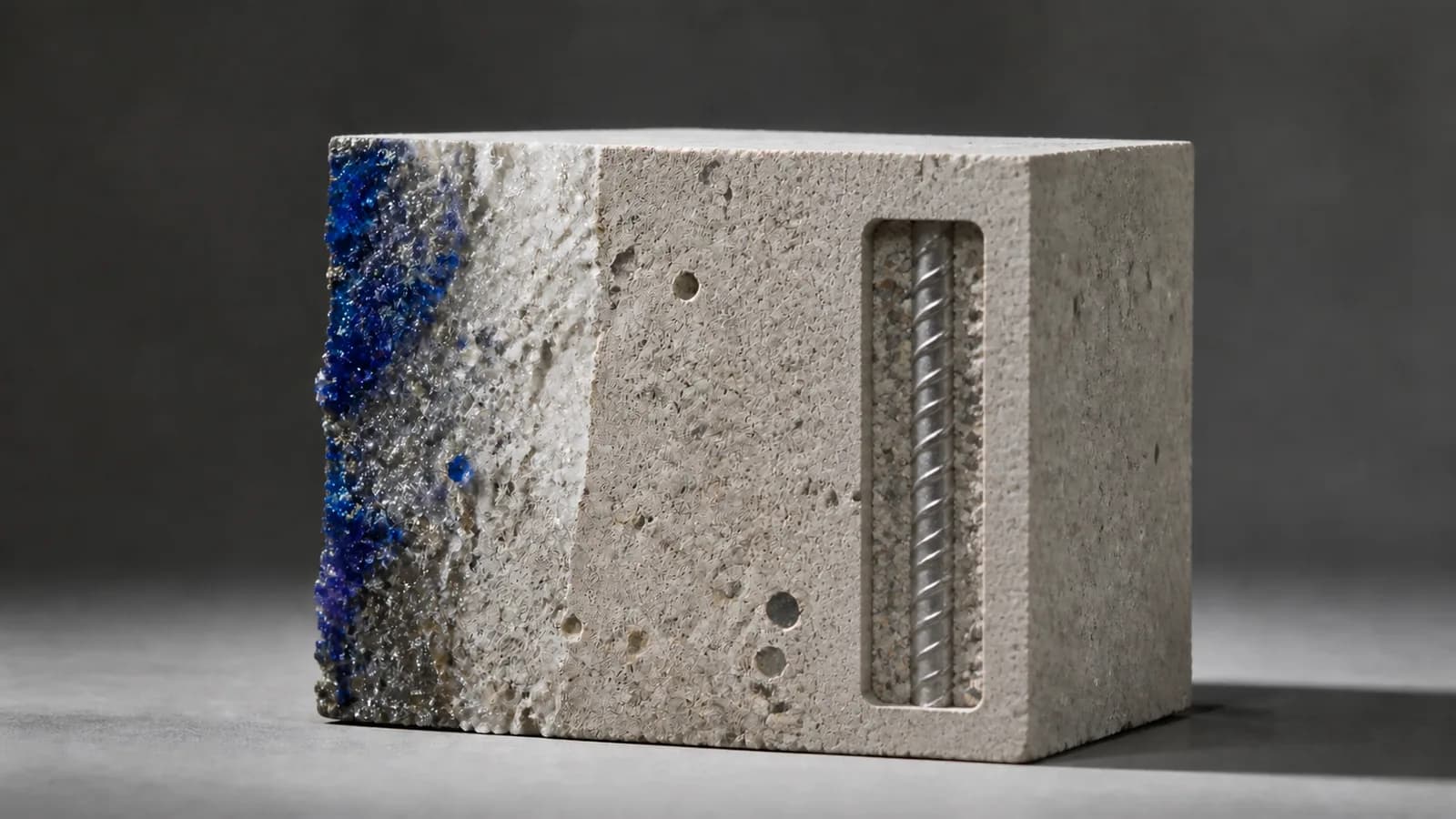
Strength is one acceptance gate, not the service-life answer
ACI CODE-318-25 places durability alongside strength and serviceability in structural-concrete design and construction. ISO 16204 goes further by framing durability as verification against known or foreseeable environmental actions over a defined service life. Together, these references support a simple management conclusion: a concrete element is not durable merely because its 28-day compressive-strength result passes. [1][2]
For an Iranian owner or project team working near the Persian Gulf, Gulf of Oman, a saline water source, or chloride-bearing soil, strength remains necessary but incomplete. It does not by itself demonstrate that cover is adequate, cracks are controlled, curing produced a dense surface zone, or the selected mixture resists the project’s actual transport mechanism. The acceptance plan must test the failure route that matters, not only the property the laboratory already measures routinely.
Classify exposure element by element
The FHWA service-life guide starts with location and exposure, then identifies the deterioration mechanisms that apply. Its coastal worked example separates exposure zones rather than assigning one generic condition to an entire asset. ACI CODE-318-25 likewise treats durability as an explicit design and construction subject. The useful lesson is not to copy another jurisdiction’s class label, but to make the responsible designer declare what each element will actually face. [2][5]
Divide the project into exposure zones before approving a mixture: direct seawater contact, splash or spray, humid sheltered surfaces, buried concrete, tanks and channels, traffic decks, and interior dry elements. Record chloride and sulfate information from project-specific water or soil investigations where relevant; identify wetting and drying, drainage defects, heat, abrasion, and access for future repair. One universal ‘marine concrete’ recipe usually hides both overdesign and vulnerable details.
- Element and face: identify which surface receives the exposure and which reinforcement it protects.
- Mechanism: state whether the control concern is chloride ingress, sulfate attack, carbonation, abrasion, cracking, or a combination.
- Consequence: distinguish replaceable finishes from foundations, piers, tanks, and other difficult-to-repair elements.
- Evidence: list the investigation, design assumption, test, inspection, and record that will close the decision.
Choose the service-life strategy before the concrete recipe
ISO 16204 provides principles for verifying durability against environmental actions and allows application to new structures when reliability and design parameters are defined. The FHWA guide describes several levels of strategy, including probabilistic modelling, partial-safety-factor methods, deemed-to-satisfy provisions, and avoidance or mitigation. It also warns that models have limits, particularly where cracking and concurrent deterioration mechanisms are not represented adequately. [1][5]
Use a proportional route. A critical coastal pier or water-retaining structure may justify specialist modelling and project-specific chloride data. A repeatable low-consequence element may be governed by a conservative prescriptive system plus verified workmanship. Whichever route is chosen, document the target service period, the limit state being avoided, assumed maintenance, exposure inputs, concrete properties, cover, crack control, and the person authorised to accept changes. A service-life number without those assumptions is decoration, not a design basis.
Use qualification tests for the question they can answer
ASTM C1202-25 measures electrical conductance to provide a rapid indication of resistance to chloride-ion penetration. It is suitable for comparing materials and proportions, but the standard stresses that specimen age and curing affect results; when used for qualification or acceptance, the specification must define curing, test age, statistical criteria, and the expected exposure. It is an indicator, not a direct measurement of long-term chloride diffusion. [3]
ASTM C1556-25 determines an apparent chloride diffusion coefficient from laboratory bulk diffusion. The standard notes that the value changes with age, includes chloride binding, and is affected by environment, finishing, mixture composition, workmanship, curing, and age. Its calculation applies to the defined sodium-chloride exposure and does not automatically describe cyclic wetting and drying. These boundaries matter when a model turns one laboratory value into decades of predicted service. [4]
A practical project can use a slower, mechanism-relevant test to qualify candidate mixtures and a faster, correlated indicator for production control. Establish the relationship using the actual cement, supplementary cementitious materials, aggregates, admixtures, mixing water, and curing regime. Do not import a universal coulomb or diffusion limit from another project. The designer and laboratory should set the criterion from the declared exposure and service-life method, then confirm that the local test can reproduce it with known variability.
Accept the concrete that was built, not only the trial mix
The 2025 ASTM methods make the dependency clear: chloride-resistance results are influenced by mixture ingredients, specimen conditioning, age, curing, workmanship, and surface condition. A laboratory-approved mixture can therefore lose its intended protection through uncontrolled water addition, delayed placement, segregation, poor consolidation, displaced reinforcement, inadequate cover, early drying, thermal cracking, or damaged curing. [3][4]
Translate the durability design into hold points. Approve the batch ticket and permitted adjustments; verify transport and discharge time against the approved procedure; measure cover before closing formwork; inspect consolidation around congested steel and embedded items; log curing start, method, continuity, and interruptions; and map cracks before handover. On hot, windy, remote, or water-constrained Iranian sites, the curing method must be demonstrably achievable with available labour, water quality, materials, backup equipment, and supervision—not merely copied into the method statement.
Write a two-stage acceptance plan into the contract
ACI PRC-329-14 identifies the essential parts of a performance requirement: the desired characteristic, sampling and testing procedures, and acceptance criteria. It also addresses responsibilities, implementation meetings, and the distribution of risk between owner and delivery team. That structure prevents a durability test from appearing after award as an undefined extra or becoming a single-result rejection rule that neither party priced or understood. [6]
Separate mixture qualification from production acceptance. Qualification proves that a proposed system can meet the design basis under stated laboratory and trial-placement conditions. Production acceptance verifies identity and consistency while site inspections verify cover, placement, curing, and cracking. Define who samples, where, how often, which laboratory is competent, how results are reported, how measurement uncertainty is handled, and what happens after a marginal or failed result. Preserve the data in the handover record so the operator inherits evidence, not a claim.
- Before tender: issue exposure zones, service-life basis, test methods, test ages, preliminary limits, responsibilities, and commercial consequences.
- Before production: approve source materials, trial batches, laboratory correlation, mock-up placement, curing method, and baseline variability.
- During production: use a declared sampling frequency, chain of custody, batch identity, cover checks, curing logs, and crack records.
- At a nonconformance: require confirmation testing and engineering review; define repair, protection, monitoring, price adjustment, or rejection routes in advance.
Pilot with local materials, then manage the evidence
Begin with one high-exposure element and the actual Iranian supply chain. Run the process from water and aggregate records through batching, transport, placement, curing, sampling, laboratory conditioning, and result review. Include an alternative material source or an allowed production variation if continuity of supply is a real project risk. The pilot succeeds when the team can repeat the control route under site conditions and explain every result—not when one carefully prepared specimen reaches a headline value.
Use a small durability scorecard: first-pass qualification rate; variability of the selected indicator; proportion of batches with complete identity records; cover nonconformities closed before casting; curing interruptions and response time; crack area mapped at agreed ages; test turnaround; and unresolved deviations at handover. Review trends by element and supplier rather than averaging away a vulnerable zone. These are operating measures, not promises of service life, but they reveal whether the design assumptions survived procurement and construction.
The point of view is firm: for chloride-exposed concrete, strength acceptance is the beginning of quality assurance, not its end. Final exposure classification, cover, mixture limits, test methods, statistical acceptance, protective systems, and repair decisions must follow the governing Iranian requirements, the signed contract, project investigations, and review by the responsible structural and materials engineers. When site evidence conflicts with the model, investigate the structure; do not edit the spreadsheet until the promise looks intact.
Sources & further reading
These primary sources support the claims and implementation frameworks used in this field note.
- 1. ISO 16204:2012 — Durability — Service life design of concrete structures
International Organization for Standardization
- 2. ACI CODE-318-25 — Building Code for Structural Concrete
American Concrete Institute
- 3. ASTM C1202-25 — Electrical Indication of Concrete’s Ability to Resist Chloride Ion Penetration
ASTM International
- 4. ASTM C1556-25 — Apparent Chloride Diffusion Coefficient by Bulk Diffusion
ASTM International
- 5. Service Life Design Reference Guide (FHWA-HIF-22-052)
Federal Highway Administration
- 6. ACI PRC-329-14 — Report on Performance-Based Requirements for Concrete
American Concrete Institute
Sources were checked on 20 August 2026. Acceptance limits must be calibrated to the project’s exposure, materials, test age, curing method, and contractual risk; this note does not replace national requirements, the contract specification, or review by the responsible engineer.