A Concrete Sensor Cannot Authorize Loading: Build a Maturity Release Gate
A practical maturity-method plan for Iranian concrete work that links mixture-specific calibration, critical sensor locations, validation, and named release authority.
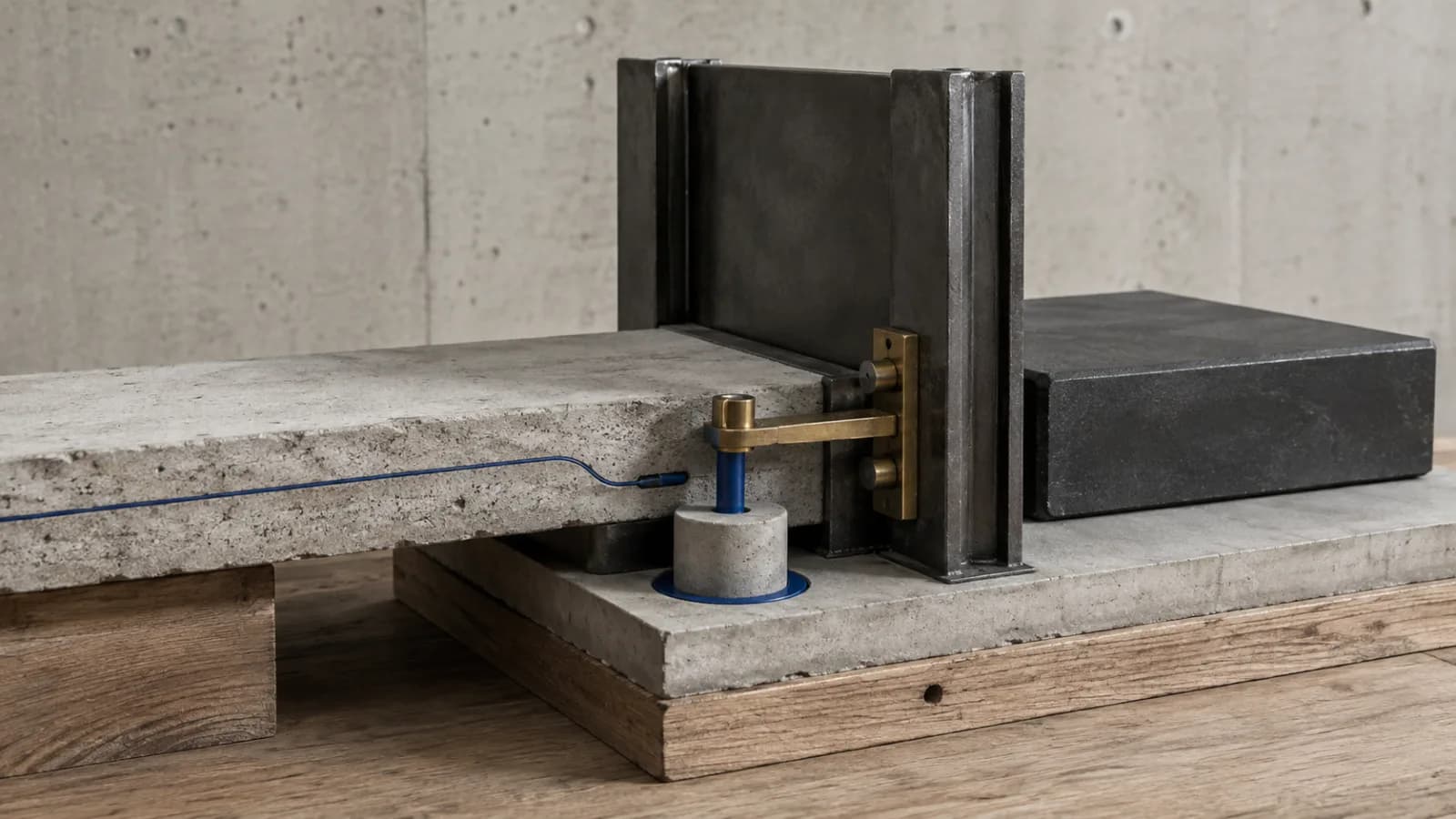
A temperature reading is not permission to load
ASTM C1074 estimates in-place concrete strength from recorded temperature history and a laboratory-established strength–maturity relationship for that mixture. It identifies formwork or reshoring removal, post-tensioning, ending cold-weather protection and opening pavement as possible uses, but also requires other indications of potential field strength. ACI 228.1R requires the method’s limitations, correlation and interpretation to be planned; NRMCA likewise calls for supplementary tests before safety-critical operations. [1][2][7]
OlbrichCo’s position is simple: buy an evidence chain, not a wireless sensor. A dashboard value should enter the release decision with the approved mixture relationship, sensor location, current validation, curing status, observed defects, load case and named authority. If a link is missing, the safe output is “not yet demonstrated”—even when the app shows a high estimated strength.
- Name each decision: strip a form, change shores, stress tendons, load a slab, saw a joint, or open pavement.
- State the required property and engineer-approved evidence; do not reuse one number for unlike actions.
- Keep raw time–temperature data, calculation, curve revision and authorization together.
- Provide a witnessed manual route when cloud access, mobile data or the vendor service is unavailable.
Calibrate the mixture that will actually be placed
ASTM C1074 requires a strength–maturity relationship before the field index can estimate strength. FHWA says project-specific materials must be used and that changes in material sources, proportions or mixing equipment require a new calibration curve. MnDOT’s procedure builds the relationship from specimens tested across a strength range that spans the intended release point. NRMCA notes that the selected maturity function and its datum temperature or activation energy are mixture-specific parameters, not defaults to inherit blindly from the device. [1][4][5][7]
Treat the curve as a controlled technical submittal. Record material sources and proportions, moisture correction, water–cementitious ratio, admixture dose, plant, fresh properties, specimen preparation and curing, sensor calibration, maturity function and constants, strength results, regression, valid temperature range and curve owner. Test points should surround the decision range; a fit dominated by later-age results can be weak evidence for early release.
- Use approved project materials and production; a curve from another project, supplier or nominal grade is not qualified.
- Pre-agree which material, proportion, plant and temperature changes trigger validation or a new curve.
- Preserve all test points and rejected results with reasons; do not retain only the fitted line.
- Have the responsible engineer approve the applicable range and decision use before embedded sensors become schedule-critical.
Instrument the concrete that controls the release
FHWA guidance places sensors according to the decision—for example near the surface for saw-cut timing—and uses multiple locations where placement time and conditions vary. NRMCA calls for locations critical in exposure and structural terms. MnDOT’s procedure adds sensors when daytime and night-time temperatures diverge and its structural specification uses at least two sensors per element, while limiting a result to concrete of the same mixture, placement period and similar curing conditions. The exact foreign spacings are not transferable design values, but the sampling principle is durable. [4][5][6][7]
Write a sensor map from the temporary load path and thermal exposure, not from radio convenience. Likely control locations include thin edges, exposed corners, shaded or wind-cooled zones, the last concrete placed, members losing form insulation, and areas furthest from active heating or protection. For post-tensioning or reshoring, coordinate with the construction-stage engineer so the monitored location represents the region that controls the operation. Use redundant sensors at consequential points and never average a cold critical location into a pass.
- Identify each sensor by pour, element, location, depth, mixture, batch and installation time.
- Photograph the fixed location before placement and protect leads or transmitters from placing, finishing and follow-on work.
- Verify clock, units, logging interval, constants, battery or reader status, and a known-temperature response before the pour.
- Define which valid sensor governs, how disagreement is investigated, and which alternative evidence applies after failure.
Validate production and stop the curve at change
ASTM C1074 warns that accuracy depends on appropriate maturity-function parameters and that the method cannot account for every effect of early concrete temperature or changes affecting potential strength. NRMCA identifies changed cementitious materials, admixtures, batching, air content and curing as sources of erroneous estimates and calls periodic verification important. MnDOT publishes a field-validation step near the intended release maturity and withdraws or re-evaluates the relationship when validation or specified mixture-change rules fail. [1][5][6][7]
Create a change register that can suspend the curve. Include changes to supplier, plant, materials, proportions, water adjustment, admixture, fresh properties, qualified temperature range, maturity constants, sensor calculation and validation. Under procurement pressure, substitution may be practical; it does not prove the old relationship remains valid. Quarantine the estimate, use the agreed backup test and requalify before restoring release authority.
- Take validation concrete from normal production and test close to the release range, not only at the conventional acceptance age.
- Compare measured strength with the current curve using a pre-agreed rule and preserve both favourable and unfavourable checks.
- Trend validation by mixture, plant, season and decision type; averages must not hide systematic overprediction.
- Version the curve and calculation so a later software update cannot rewrite the basis of an earlier release.
Do not let early strength cancel curing or acceptance
ASTM C1074 states that concrete must remain in a condition that permits hydration, that maturity does not capture the effect of early-age temperature on long-term strength, and that other evidence of potential strength is still needed. ASTM C31 assigns standard-cured specimens to specified-strength acceptance and field-cured specimens to separate in-place and curing questions. The new ACI 308-26 guide addresses external curing procedures, monitoring, quality control and inspection across structures, slabs and pavements. A maturity estimate therefore does not prove curing quality, durability, crack control or final specified strength. [1][3][8]
Keep four gates visible: permission for the immediate construction operation; compliance with the approved curing and protection plan; acceptance of specified strength; and acceptance of other required performance such as durability, surface quality or cracking. In hot, dry, windy or highly variable site conditions, rapid temperature accumulation can coexist with moisture loss or damaging gradients. Removing forms may also remove useful moisture and thermal protection. Any change after release needs an explicit curing, temperature, loading and reshoring plan.
- Continue curing and protection until their own completion criteria are met.
- Keep standard-cured acceptance tests and any required durability tests on their contractual routes.
- Inspect cracking, surface distress, curing interruption, impact and overload before signing the release.
- Record the post-release shore, load, temperature and moisture controls—not only the moment of permission.
Pilot one release cycle and measure decision quality
Pilot the method on one repeated, consequential operation: a slab strip and reshore cycle, a wall form release, one post-tensioning stage, a precast handling lift, or a pavement opening. Before placement, approve the decision basis and mixture curve; commission sensors and the offline readout; witness placement; compare estimates with validation tests around the release point; issue or refuse the permit; then follow curing, loading and final acceptance through closure. Do not shorten the programme during the pilot merely to manufacture a benefit claim.
Measure missing or failed sensors, traceable records, validations completed before use, estimation error near the decision point, release requests accepted first pass, hours between demonstrated readiness and authorized action, unauthorized loads, curve suspensions, curing deviations after release, and final acceptance outcomes. The purpose is not “faster concrete” but a more defensible decision at the earliest safe time. Scale only when the same evidence survives a mix change, a difficult temperature cycle, a lost connection and a shift handover.
- Zero releases without an approved curve, valid controlling sensors, current validation and named signature.
- Zero curve reuse after an unreviewed material, proportion, plant or calculation change.
- Every release linked to its exact raw data, calculation version, field observations and backup evidence.
- Every pilot lesson converted into a specification, method statement, inspection point or training change before expansion.
Sources & further reading
These primary sources support the claims and implementation frameworks used in this field note.
- 1. ASTM C1074-19e1 — Standard Practice for Estimating Concrete Strength by the Maturity Method
ASTM International
- 2. ACI PRC-228.1-19 — Report on Methods for Estimating In-Place Concrete Strength
American Concrete Institute
- 3. ASTM C31/C31M-26b — Standard Practice for Making and Curing Concrete Test Specimens in the Field
ASTM International
- 4. FHWA-IF-06-004 — Maturity Testing for Concrete Pavement Applications
U.S. Federal Highway Administration
- 5. Maturity Method Procedure — Estimating Concrete Strength by the Maturity Method
Minnesota Department of Transportation
- 6. Specification 2461.3.G.6 — Estimating Concrete Strength by the Maturity Method
Minnesota Department of Transportation
- 7. CIP 39 — Maturity Methods to Estimate Concrete Strength
National Ready Mixed Concrete Association
- 8. ACI PRC-308-26 — Curing of Concrete—Guide
American Concrete Institute
Sources were checked on 4 September 2026. The foreign standards and agency procedures do not create Iranian legal obligations, release strengths or curing regimes. Final required strength, estimation method, sensor locations, validation rules, release authority, curing and acceptance must follow governing requirements, the signed contract, the actual mixture and materials, site conditions, and responsible professional review.