Concrete Repair: Diagnose the Damage Before Specifying the Patch
A sound-looking patch is not proof of a successful repair. Define the damage mechanism, choose tests that answer the right question and accept the outcome the owner actually needs.
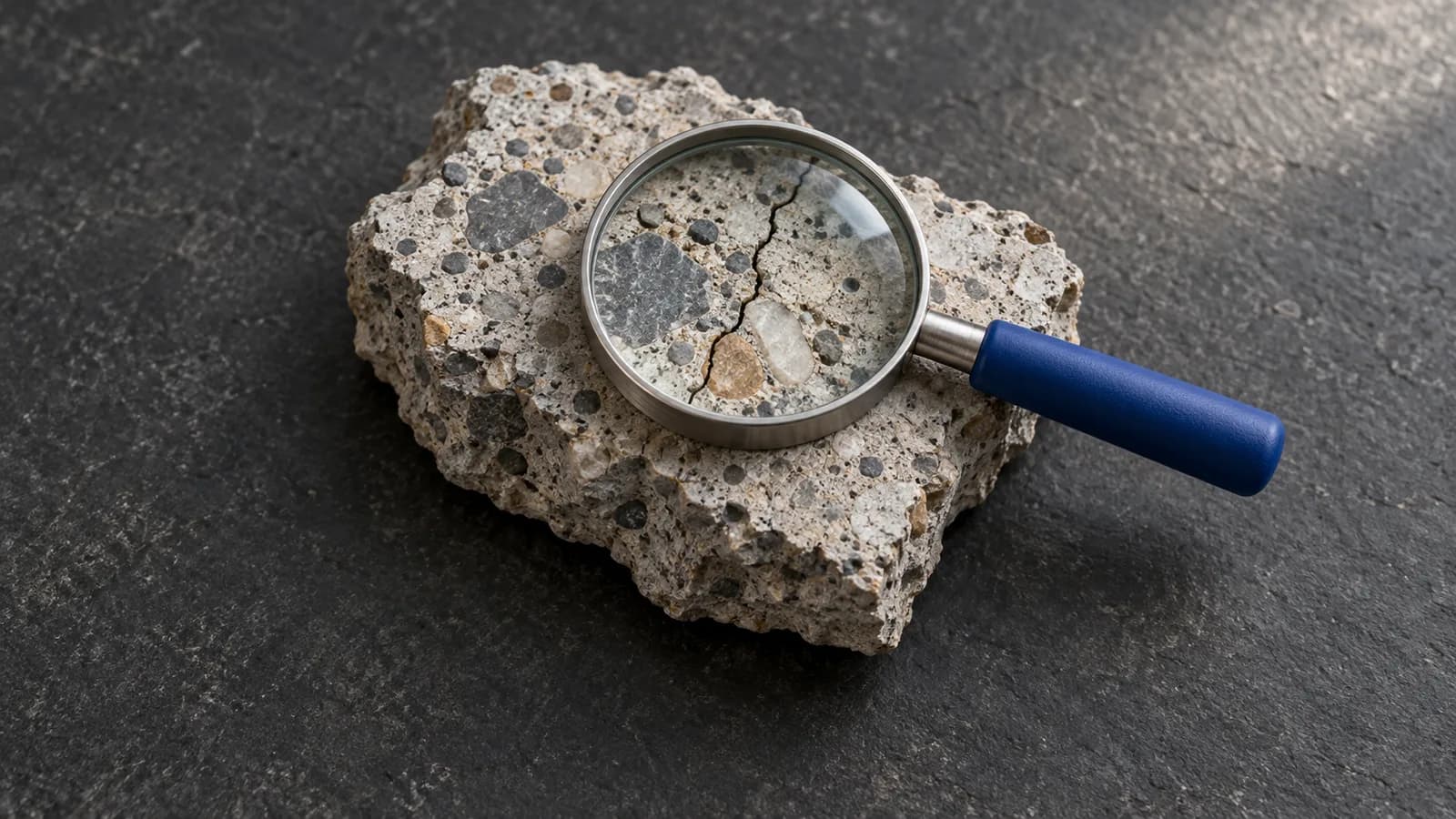
Specify the repair’s job before specifying its material
ACI’s public description of CODE-562-25 places assessment of damaged or deteriorated existing concrete structures alongside the design of appropriate repair and rehabilitation strategies. It addresses existing structures rather than treating repair simply as new construction. [1]
OlbrichCo’s position is to commission a defined outcome, not a bag of high-strength mortar. Ask whether the work is intended to restore appearance, control water entry, address reinforcement corrosion or restore structural capacity. Record which outcomes are included and which remain outside the package; do not allow a neat finish to stand in for evidence of all four.
For an occupied building or industrial facility in Iran, start with a joint brief from the owner, responsible engineer and operator. Identify the element, its function, access constraints, permitted shutdowns and consequences of recurrence. Give the engineer responsibility for deciding whether the proposal is local maintenance, an engineered repair or a wider rehabilitation investigation.
Make safety clearance a separate decision. Where instability, falling concrete, fire damage or consequential structural deterioration is suspected, restrict access and obtain competent engineering direction before investigation or repair. Do not authorize exploratory chipping through a cosmetic-work order. Structural capacity, seismic adequacy, temporary support and return to service require project-specific engineering decisions.
Buy a diagnosis with a location and a confidence level
Reclamation’s 2015 guide places determining damage causes, evaluating extent and deciding whether repair is needed before selecting a method or material. Its condition-survey approach distinguishes the cause of damage from the visible symptom. [2]
Turn that sequence into a short investigation brief. Request a located defect map, exposure and leakage history, available structural drawings, previous repairs and an account of what remains inaccessible. Give each area an identifier shared by photographs, samples, test results and subsequent work records. Mark observations, hypotheses and confirmed findings differently.
Ask the engineer to identify the evidence needed to distinguish the competing explanations for each defect. A sample should have a stated question, a planned location and a decision it could change. Agree safe access and authorized sampling with the engineer, including checks for reinforcement, prestressing and services; the investigation must not create an uncontrolled opening or weaken an element.
Require the diagnosis to state its coverage and uncertainty, not merely name a deterioration mechanism. For an Iranian project with limited laboratory access, agree available methods, specialist competence and realistic turnaround before tender. If uncertainty remains, price an investigation stage and a controlled change mechanism rather than presenting the visible patch area as a fixed final quantity.
A corrosion map is not a measure of remaining capacity
ASTM G225-26, updated in June 2026, distinguishes corrosion-rate measurement from potential mapping, which does not quantify reinforcement diameter loss. Its public guidance calls for interpretation by specialists experienced in corrosion testing and structural evaluation. [3]
Our practical recommendation is to require every proposed measurement to declare its decision boundary. Ask whether it helps locate further investigation, estimate current corrosion activity, characterize material condition or support a structural calculation. Reject a report that silently changes from one question to another, or presents a coloured map as permission to close the repair.
Do not infer historical steel loss from a single current-rate reading. Commission a separate, engineer-defined assessment of residual reinforcement and structural consequences where those matters control the decision. Ask the specialist to document equipment, measurement conditions, coverage and interpretation limits; retain the underlying results, not only the summary graphic.
For the owner’s review, request a plain-language conclusion in Persian alongside the technical record: what is known, what remains uncertain, which work may proceed and who must resolve the remaining question. Keep an offline copy linked to the defect identifiers. Instrument availability or an attractive report should not dictate the repair strategy.
Procure a compatible repair system, not the highest strength
Reclamation’s repair-compatibility research abstract describes cracking and debonding as routes for renewed ingress of water, air and chlorides. The project investigates compatibility between repair materials and existing concrete as a durability issue. [4]
Use that concern to structure the submittal. Ask the designer to set the required properties for the actual substrate, exposure and repair geometry, including the relevance of shrinkage, stiffness, bond, application thickness and curing. Require evidence supporting the proposed system and its interfaces; do not substitute a compressive-strength ranking for a compatibility review.
For Iranian procurement, first verify what can actually be supplied, stored and applied during the planned work window. Ask for product identity, batch traceability, shelf life, mixing and application instructions, and a documented route for approving substitutions. Agree who funds requalification when a replacement material changes the approved method. Do not imply that a familiar brand removes that obligation.
Make climate and access explicit project inputs. If the work faces hot dry wind, coastal exposure or cold-weather application, require a method that addresses the conditions actually expected at that location, including protection and curing arrangements. Check whether the facility can sustain the proposed closure and maintenance obligations. These are project questions, not assumptions about every Iranian site.
Use a trial to agree execution and evidence before concealment
ASTM C1583/C1583M-25 describes pull-off testing of concrete surfaces and repairs. Failure may occur in the substrate, interface or repair material; its public guidance requires recording the failure mode and averaging only results with the same mode. [5]
Propose a representative trial area before repetitive work. Have the engineer define its scope, applicable full test methods, sampling plan, test age, acceptance limits and response to failure before installation. There is no universal acceptance value in this note. Include the actual crew, equipment, substrate preparation, material and curing arrangements intended for the main works.
Write explicit inspection holds into the agreed method: before removal starts, after the prepared area is exposed and before reinforcement or interfaces are concealed. Record who can release each hold. If the revealed condition differs from the diagnosis, stop that area for engineering review, revise the scope and authorize the change before proceeding; do not ask the installer to improvise a structural decision.
Maintain a compact area record: approved detail and revision, photographs at the holds, material batch, application conditions, preparation checks, curing record and linked test results with failure locations and modes. Agree repair of test locations too. Accept or reject the defined area against the agreed criteria; a convenient overall average must not erase a local failure requiring investigation.
Close the intended outcome, then plan the next observation
At handover, reconcile completed work against the defect map and the original outcome brief. For a water-control objective, specify an appropriate engineer-approved verification and observation period; for a corrosion-control objective, define the specialist’s follow-up evidence. Where capacity was part of the scope, obtain the responsible engineer’s acceptance. Do not treat a bond-test result as proof of every objective.
We propose a small owner’s scorecard: accepted repair area divided by completed area; overdue investigation or inspection holds; failed tests by failure mode; unresolved causes of deterioration; and reopened locations at the agreed revisit. State denominators and dates. These are proposed management measures, not performance benchmarks or promised service-life gains.
Schedule the revisit around the relevant operating or exposure condition, not just the end of the payment period. Assign an owner for collecting comparable photographs and observations from the same locations, and a route for escalating new cracking, leakage or other changes. Set the timing and response criteria with the engineer and operator before demobilization.
The commercial decision is then clearer: pay for evidence-backed investigation, an approved repair scope and demonstrable acceptance, while keeping unresolved risks visible. A smaller repair may be justified, or the assessment may require a wider intervention; neither should be predetermined by the material already purchased. Contracts, applicable requirements and competent local engineering review govern the final decision.
Sources & further reading
These primary sources support the claims and implementation frameworks used in this field note.
- 1. ACI CODE-562-25: Assessment, Repair, and Rehabilitation of Existing Concrete Structures — public description
American Concrete Institute
- 2. Guide to Concrete Repair, 2015 — Part I, sections A.1 and B.1–B.3
US Bureau of Reclamation
- 3. ASTM G225-26: Electrochemical Measurement of Corrosion Rate of Metals in Field Concrete Structures — public scope and significance
ASTM International
- 4. Repair Material Compatibility Requirements for Long Term Concrete Repairs — research project 385 abstract
US Bureau of Reclamation
- 5. ASTM C1583/C1583M-25: Direct Tension (Pull-off) Testing of Concrete Surfaces and Repairs — public scope and significance
ASTM International
Sources checked on 16 September 2026. Numbered paragraphs summarize source material; other paragraphs are OlbrichCo’s proposed workflow and decision criteria, not reported project results or standard clauses. ACI and ASTM references use their public descriptions, not the full paid standards. The Reclamation guide concerns water infrastructure; only its diagnostic planning principles are transferred here, alongside a separate research-project abstract. These international references are not presented as Iranian law. Project contracts, applicable requirements, competent local engineering review and actual site conditions govern.