The Model Fits; the Building May Not: Gate Every Off-Site Interface
A tolerance-control plan for Iranian prefab, precast, steel, façade and MEP packages that verifies physical fit before fabrication and lifting.
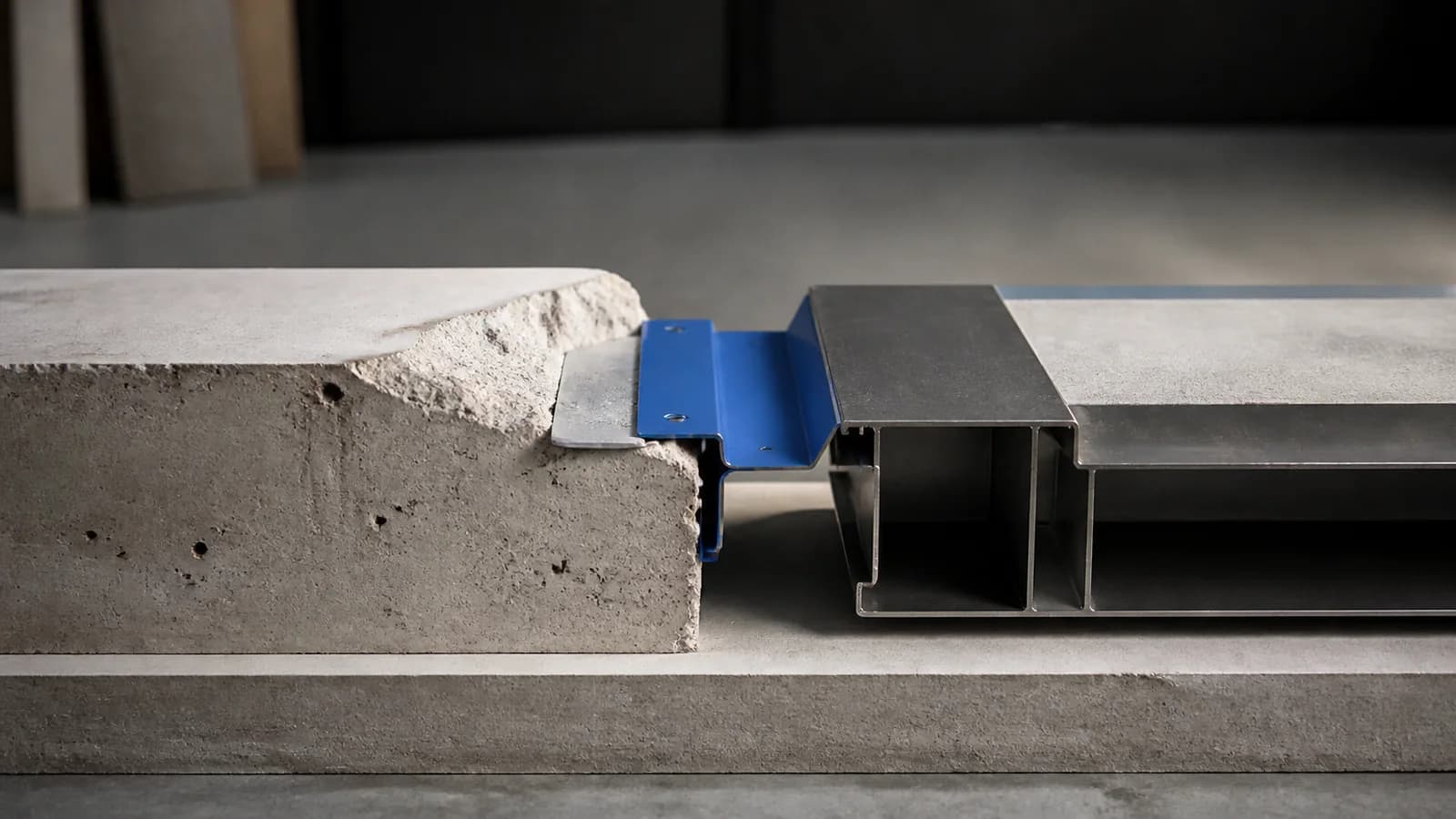
Factory precision cannot rescue an undefined interface
Singapore's Building and Construction Authority defines DfMA as designing construction for manufacture off site in a controlled environment and assembly on site, across precast, volumetric, MEP and steel systems. That shift can improve control inside the factory, but the completed product still has to meet cast concrete, masonry, structure, services and survey control that were produced by other processes. [1]
OlbrichCo analysis: the valuable unit of control is the interface, not the module. A millimetre-perfect rack can fail to enter a shaft; a precast panel can be within its production tolerance and still miss an embed; a façade cassette can fit geometrically while losing movement, drainage or fire continuity. Do not release repetitive manufacture merely because the federated model is clash-free. Release it only when the project can show that the whole tolerance chain has a workable fit.
Turn functional fit into an interface tolerance budget
ISO 3443-4 provides principles for predicting deviations in composite assemblies and allocating tolerances to constituent elements so the assembly can meet its functional requirements. ACI's tolerance-compatibility guide makes the same problem concrete: embedded items, openings, cladding, infill, stairs and finishes can each be acceptable under their own rules while their interface remains incompatible. It recommends early coordination and says project requirements drawn from the guide must be restated in mandatory contract language. [2][4]
Begin with the function that must survive: bearing, bolt engagement, weld access, sealant geometry, drainage, fire stopping, acoustic separation, insulation continuity, maintainability, replaceability and safe erection. Then allocate a signed tolerance budget across design geometry, host construction, fabrication, erection, survey uncertainty, movement and the adjustment device. Worst-case addition is conservative; statistical combination needs competent justification and suitable process data. Never hide an impossible sum inside a generic note saying dimensions shall be verified on site.
- Show nominal dimension, permitted positive and negative deviation, measurement datum and adjustment range in one interface schedule.
- Separate production, erection and interfacing tolerances; do not spend one party's allowance twice.
- Check the adverse combinations, not only the neat nominal section shown in the model.
- Reserve adjustment for expected variation, not for unreviewed structural cutting, forced alignment or loss of cover.
Freeze one datum, coordinate system and revision before measuring
ISO 4463-1 treats site measurement as a controlled sequence: establish the primary framework, set reference lines, transfer them through the building, set out position points and level them with defined procedures and acceptance criteria. ANSI/AISC 303-22 likewise places fabrication and erection tolerances within a contractual framework and calls for additional tolerances required by the design concept to be identified in the contract documents. A coordinate without provenance is not a release basis. [3][6]
Issue a fabrication-release record that names the survey control, coordinate system, units, grid and level convention, drawing and model revision, measurement date, instrument, calibration status, weather where relevant, operator, raw record, transformation and approval. Preserve Persian field descriptions alongside stable element IDs where useful, and make the offline record authoritative when connectivity is weak. Re-establish and verify control after movement, damage, floor transfer, structural loading or a changed survey network; do not merge point sets until their references are proven compatible.
- One owner maintains the project control network; trade surveys connect to it through recorded checks.
- One element ID links model object, drawing, survey point, fabrication item, delivery and installed position.
- One status distinguishes design intent, measured host condition, approved fabrication geometry and final as-built.
- One change rule invalidates dependent releases when the datum, revision or host geometry changes.
Measure the host work before repetitive manufacture
ISO 3443-8 applies dimensional quality-control procedures to construction work and calls for the relevant procedures and agreed items to be understood by project parties. PCI 135-25, developed through PCI's ANSI-accredited process, now supplies a current specification for precast tolerances across manufacturing and building phases and supersedes the tolerance provisions of MNL 135. Both point away from informal spot checking and toward a defined acceptance record. [5][9]
Choose the release sample by consequence and repeatability. Before a long production run, survey actual embeds, slab edges, openings, shafts, bearing surfaces and service connection points in the first completed zones. Compare the cloud or point file with the interface schedule, not only with nominal geometry. Quarantine outliers; verify the measurement; decide whether to repair the host, alter the manufactured part within an approved design envelope, or revise the system. A scan made after every unit is fabricated is documentation of risk, not control of it. [2][3]
- Use independent check points that were not used to create the same survey fit.
- Sample concealed and high-consequence interfaces, not only the easiest visible edge.
- Report uncertainty and inaccessible areas; dense points do not eliminate an unmeasured surface.
- Define stop, repair, redesign, concession and remeasure routes before the first nonconformance arrives.
Design adjustment capacity; do not improvise it during the lift
ACI PRC-117.1-14 focuses on compatibility where concrete meets other systems, while PCI 135-25 distinguishes the tolerances that govern precast manufacture and erection. AISC 303-22 similarly separates steel fabrication and erection requirements. The transferable principle is that compliance of each component does not automatically prove the assembled interface; connection geometry and responsibility must bridge the standards and trades. [4][5][6]
Detail a controlled adjustment envelope: slots, shims, levelling devices, closure pours, sleeves, couplers, sealant joints or replaceable transition pieces only where structural, seismic, fatigue, corrosion, fire, water, acoustic and maintenance consequences have been designed. State permitted combinations, edge distances, bearing, tightening or welding sequence, inspection and permanent closure. On an Iranian project, qualify realistic locally available materials and an approved fallback before factory release; an unavailable proprietary connector can turn a precise package into field improvisation.
- No flame-cut enlargement, forced fit, site drilling, rebar cutting or packer stack without the named design and inspection route.
- A concession records the exact item, deviation, analysis, consequence, remedy, approver and as-built evidence.
- Movement allowance remains available after erection; do not consume thermal or seismic capacity to correct setting-out error.
- Mock up the hardest repeated interface with actual crews, tools, access, lifting sequence and inspection hold points.
Use the model as an evidence carrier, not a fit certificate
ISO 7817-1:2024 establishes a method for specifying the detail and extent of information needed in BIM exchanges. buildingSMART's IDS 1.0 makes selected information requirements readable by people and machines and supports automated checking that required data is delivered. These tools can verify that an object carries a datum, status, tolerance class or survey reference; they do not measure the concrete, validate instrument uncertainty or prove that two physical parts will assemble. [7][8]
Create a small, open exchange rather than demanding an oversized model. For each controlled interface, require stable IDs, revision and status; nominal geometry; tolerance and adjustment fields; host-survey reference; deviation result; release decision; approved concession; and installed verification. Validate the data automatically where practical, then retain the signed measurement and decision record outside any single vendor platform. The model should lead a site team to evidence it can use offline—not to a green colour that conceals an unknown basis.
Pilot one repeated interface and measure first-fit assembly
Select one consequential, repeated boundary: a precast-to-foundation bearing, façade anchor line, steel-to-concrete embed, prefabricated riser, bathroom pod or MEP rack connection. In one cycle, build the tolerance budget, verify survey control, measure the host, fabricate a representative unit, trial the full lifting and connection sequence, close deviations and capture the final state. Include one simulated datum change and one unavailable component so revision and fallback routes are tested before production volume removes flexibility.
Use three scorecards. Geometry: host points within the allocated band, survey checks passed, adjustment consumed and residual movement capacity. Flow: first-fit rate, fabrication releases later invalidated, field modifications, concession age and time from measurement to decision. Outcome: connection acceptance, unresolved structural or enclosure deviations, damage during fit-up, repeatable installation time and complete as-built evidence. Report denominators and interface families; an average can hide the one repeated detail creating most rework.
Scale only when the project can reproduce the coordinate basis, predict adverse tolerance combinations, procure the designed adjustment and assemble without unsafe force or undocumented modification. Foreign standards do not set an Iranian project's limits. The signed contract, governing Iranian requirements, actual materials, transport and lifting conditions, and responsible structural, seismic, enclosure, MEP, fire, survey, fabrication and construction review control the final release and acceptance.
Sources & further reading
These primary sources support the claims and implementation frameworks used in this field note.
- 1. Design for Manufacturing and Assembly (DfMA)
Building and Construction Authority of Singapore
- 2. ISO 3443-4:1986 — Tolerances for building: Predicting deviations of assemblies and allocating tolerances
International Organization for Standardization
- 3. ISO 4463-1:1989 — Measurement methods for building: Setting-out and measurement
International Organization for Standardization
- 4. ACI PRC-117.1-14 — Guide for Tolerance Compatibility in Concrete Construction (official preview)
American Concrete Institute
- 5. PCI 135-25 — Specification for Tolerances of Precast Concrete
Precast/Prestressed Concrete Institute
- 6. ANSI/AISC 303-22 — Code of Standard Practice for Steel Buildings and Bridges
American Institute of Steel Construction
- 7. ISO 7817-1:2024 — Building information modelling: Level of information need — Concepts and principles
International Organization for Standardization
- 8. Information Delivery Specification (IDS) v1.0 — Final Standard
buildingSMART International
- 9. ISO 3443-8:1989 — Tolerances for building: Dimensional inspection and control of construction work
International Organization for Standardization
Sources were checked on 2 September 2026. The foreign standards and guidance do not create Iranian legal obligations or tolerance limits. Final limits, survey basis, measurement method, adjustment capacity, connections, structural, seismic, fire and weather requirements, and acceptance must follow governing requirements, the signed contract, approved documents, actual site conditions, and responsible professional review.