Temporary Works Need a Permit to Load, Not Just a Drawing
A site-ready control plan for Iranian projects that connects every prop, platform, excavation support, and formwork system to a brief, checked design, inspection, and authorised release.
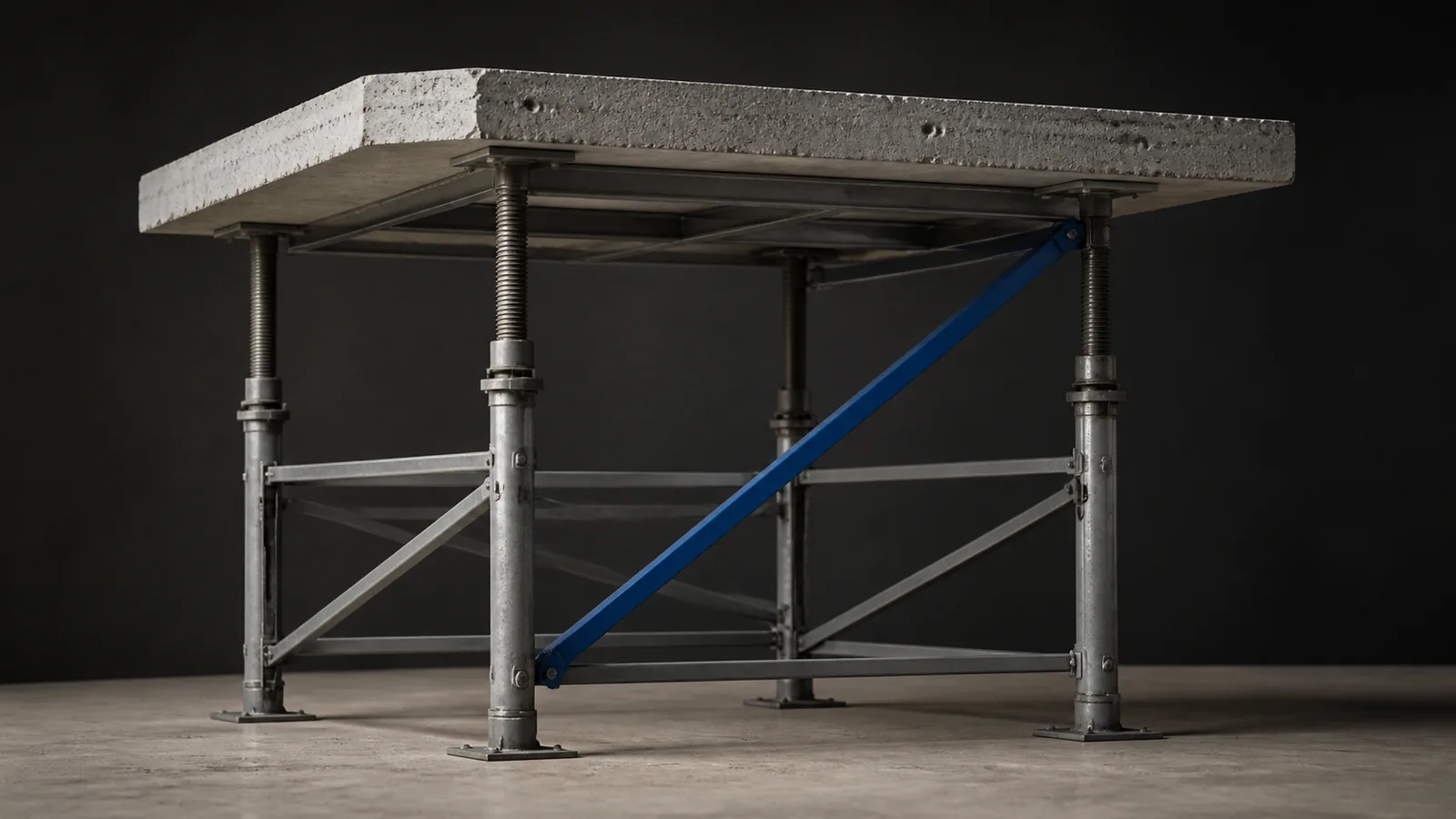
Temporary is a service condition, not a lesser structure
At the end of 2024, BSI replaced BS 5975:2019 with two current parts. Part 1 covers management from conception and design through use and dismantling; Part 2 covers falsework design and implementation, including proprietary systems, wind, foundations, and limit-state and permissible-stress approaches. The split separates two questions projects often confuse: is the solution structurally adequate, and does the process control what is built and loaded? [1][2]
For an Iranian owner, consultant, or contractor, the lesson is not to import a British title or calculation method. Give temporary works the same decision discipline as permanent works. A correct drawing can fail operationally when ground assumptions are wrong, components differ, the sequence changes, another trade adds load, or release is only verbal. Design and field control must meet at a recorded loading decision.
Find the temporary works before they find the programme
HSE describes temporary works broadly: excavation shoring, wall and floor props, falsework, access scaffolds, crane and plant working platforms, haul roads, cofferdams, hoarding, temporary earthworks, and even permanent works used in a temporary condition. These are engineered solutions that support, protect, restrain, or provide access while the permanent asset is incomplete. A register limited to formwork misses many of the interfaces most likely to be improvised late. [3][6]
Create one live register before packages split among subcontractors. Give every item an owner, location, purpose, need date, design basis, risk band, designer, checker, drawing revision, installation, inspection and permit status, monitoring trigger, and removal condition. Use one identifier on the register, drawing, inspection sheet, and physical zone. An offline form is sufficient if controlled, backed up, and available where work happens.
- Register what carries load, restrains movement, retains ground or water, protects the public, or creates access—not only billed falsework.
- Record interfaces with permanent works, soil, adjacent structures, utilities, traffic, cranes, concrete strength, weather, and other trades.
- Name who may release loading, alteration, and removal; design authorship does not assign those site decisions.
- Flag long-lead proprietary parts and the approved fallback before supply pressure creates an unreviewed substitution.
Write the site condition into the design brief
HSE's current FAQ warns that a standard solution remains conditional: the organiser must confirm that site ground and all calculation assumptions match the actual case. It also notes that proprietary props still require a competent assessment of vertical and lateral loads. Safe Work Australia's falsework guidance calls for drawings to state assumptions, loads, expected dimensional changes, member details, erection procedures, bracing, connections, foundations, and safe access; it also highlights site-specific ground conditions where falsework foundations depend on them. [4][7]
The brief is the contract between site and designer. State geometry and sequence; permanent-work capacity by stage; relevant concrete, material, plant, worker, impact, wind, water, soil, and accidental actions; bearing and drainage; component availability and condition; exclusion zones; inspection access; tolerances; monitoring; and evidence for loading and removal. Mark unknowns: an assumption without an owner is a latent change.
- Issue a sketch and photographs with dimensions and reference levels; do not ask the designer to infer the site from a phone call.
- Use clear Persian site labels alongside stable drawing codes, SI units, material grades, and revision status where that helps the installing crew.
- State permitted proprietary components and adjustment ranges; mixed or locally fabricated parts need their own verified basis.
- Define the pour, lift, excavation, back-propping, or dismantling sequence as a design condition, not a method-statement afterthought.
Match the check to complexity and consequence
BS 5975-1:2024 applies procedural controls across temporary-works roles and recognises that control should be proportionate to project scale and complexity. HSE similarly says that all but the simplest situations normally need a design with calculations, while more complex work may need an independent check. The important principle is independence of judgement where the risk justifies it—not paperwork volume for its own sake. [1][3]
Use a project risk band rather than copying a foreign checking category without its definitions. A documented supplier configuration within every stated limit may receive a competent configuration check. A site-specific conventional solution should be checked by someone who did not produce the calculation. Unusual geometry, high consequence, excavation or groundwater uncertainty, interaction with an incomplete permanent structure, heavy plant, public exposure, or novel mixed systems justify a more independent and experienced reviewer. The design brief and checker appointment should agree before calculation starts.
- Escalate when failure consequence grows, not merely when the drawing becomes visually complicated.
- Escalate when assumptions cannot be inspected directly or when load sharing depends on erection sequence and stiffness.
- Do not let programme urgency reduce the check; reduce scope, loading, or exposure until the authorised review can be completed.
- Close comments against a named revision and preserve the calculation, drawings, product data, and approval trail together.
Make loading a hold point with a named release
The U.S. OSHA formwork rule requires drawings and revisions for formwork, shoring, working decks, and scaffolds to be available at the jobsite; it also requires shoring checks before erection and inspections immediately before, during, and after concrete placement. Safe Work Australia's guide calls for a competent person to inspect and certify installed falsework against the design before loading, and for loading to be monitored with a communication route for an emergency. These are foreign requirements, but they expose the same management gap: a drawing does not verify the erected condition. [5][7]
Use a short permit to load—or permit to excavate, access, tension, or pour—signed by the person authorised in the project procedure. The inspection must compare the actual system with the released revision: grid and levels, component identity and condition, base and top contact, bracing and locks, foundations and drainage, ties and interfaces, edge protection, access, exclusion zones, monitoring points, and open deviations. Attach photographs that identify the zone, but never let photographs replace measurements or a physical inspection. A permit with unresolved conditions should state the limited load or operation it allows.
- Design released and check comments closed against the revision present on site.
- Installation inspected before it is concealed or made inaccessible.
- Ground, supports, connections, bracing, components, and interfaces match recorded assumptions.
- Loading sequence, maximum site storage, exclusion controls, monitoring, and emergency communication are briefed.
- Deviations are accepted by the right designer and checker—not annotated after loading begins.
Treat alteration and removal as new load cases
HSE notes that temporary works are easily affected by nearby operations and gives the coordinator a role in preventing other activity from damaging or compromising them. OSHA requires formwork revisions at the site and links shore removal to demonstrated permanent-work capacity. Safe Work Australia's falsework guide calls for written confirmation that the permanent structure is self-supporting before removal and for back-propping arrangements to be verified. [3][5][7]
Define change triggers in the permit: substituting a prop or brace, extending a jack beyond the approved range, removing one member for access, adding stored materials, changing the pour rate, attaching screens that attract wind, saturating the bearing ground, deepening a nearby excavation, changing plant position, seeing settlement or distortion, or altering the back-propping sequence. Stop the affected operation, stabilise the condition, record the change, obtain design review, inspect the revision, and issue a new release. A red mark on an old drawing is not change control unless authority and consequences are clear.
Removal needs its own permit because the load path is moving from the temporary system into an incomplete permanent asset. Define the evidence for strength or stability, the unloading sequence, residual back-propping, exclusion zone, monitoring, and who confirms completion. Contract terms, governing requirements, project tests, environmental conditions, and the responsible structural or geotechnical engineer control the final decision; a generic number of days does not.
Pilot one load cycle and measure control quality
Pilot the procedure on one repeatable, consequential item: a typical slab falsework bay, excavation support stage, façade access platform, or crane working platform. In 30 days, map the item, issue the brief, set the risk band, complete design and check, inspect the installation, release loading, record any monitoring and change, then authorise removal. Run the paper or offline path under actual site connectivity and shift patterns. The pilot succeeds when the same evidence can be understood by the site, designer, checker, and owner without reconstructing decisions from messages.
Keep the scorecard operational: items registered before need date; briefs and inspections accepted first pass; designs and checks released before installation; open deviations at loading; unauthorised alterations; decision time; permits linked to the correct revision; monitoring actions; and removals with capacity evidence. Track by system and subcontractor so averages do not hide a weak interface. These measures show whether the control chain works; they do not prove safety alone.
The point of view is firm: temporary works are not safe because they are temporary, familiar, or rented from a reputable supplier. They are safe enough to use only when project-specific assumptions, a proportionate checked design, the installed condition, controlled loading, active change management, and a deliberate transfer of load agree. Final acceptance remains with the parties and professionals authorised by the applicable Iranian requirements and signed contract.
Sources & further reading
These primary sources support the claims and implementation frameworks used in this field note.
- 1. BS 5975-1:2024 — Temporary works: Management procedures for the control of temporary works
British Standards Institution
- 2. BS 5975-2:2024 — Temporary works: Falsework design and implementation
British Standards Institution
- 3. Temporary Works — construction safety topic
UK Health and Safety Executive
- 4. Temporary works FAQs
UK Health and Safety Executive
- 5. 29 CFR 1926.703 — Requirements for cast-in-place concrete
U.S. Occupational Safety and Health Administration
- 6. General Guide for Formwork and Falsework
Safe Work Australia
- 7. Guide to Falsework
Safe Work Australia
Sources were checked on 25 August 2026. They describe international practice and requirements in their own jurisdictions; they do not create Iranian legal obligations. Final design, checking, permits to load or dismantle, and site controls must follow governing requirements, the signed contract, actual conditions, manufacturer instructions, and responsible engineering review.